Electro-Magnetic String Resonators
Home
Chapter 1
Introduction
:
Temporal Perspectives
The chapters that follow hope to outline the paths of research committed
over the past 2 years. Beginning with studies into the various definitions and states
of time, we’ll then move on to the physiological effects of sound and its
connection to bioremediation. Deep Listening as a holistic practice and how sound
is intertwined with environmental health. Chapter 3 will then move on to the
forces of gravity and magnetism, which is the underlying genesis of the
instruments that were created.
Chapters 4 and 5 will dive into my ecological studies, beginning with
a report on the work of Viktor Schauberger, who made interesting strides in water,
energy and ecology. When working with any environmental practice, water is
eternally fundamental. Understanding natural cycles or processes can inform us as
to where can take technology and Schauberger viewed Nature as its own
technological system that could be observed and utilized for technological
innovation in symbiosis with the natural world.
From water we’ll move to my ongoing bioremediation research and
practices in Los Angeles. The remediative properties of fungi and how practices
can be incorporated locally through community building activation.
Time is perceived differently between organisms and even varies
significantly across different parts of the Universe. Space and time are interrelated
dimensions (often conceptualized together as spacetime in physics), but they are
not identical. Spacetime is a single, four-dimensional continuum where time acts as
the fourth dimension. This conceptualization helps in understanding the relativistic
effects where time is affected by movement through space and by the gravitational
pull of masses. Despite their connection, space and time exhibit distinct properties:
space is described through three dimensions, while time has only one.
The concept of time is often perceived through changes in the environment,
which can include the growth cycles of mycelium (the vegetative part of fungi), the
flow and phases of water, and the rhythms and frequencies of sound. Mycelium
can affect soil properties and plant growth cycles, influencing how we measure
time in an ecological context. Water, with its cycles and movements, impacts our
perception of time through natural rhythms such as tides and seasons. Sound,
through its vibrations and the way it’s processed by our auditory system, can alter
our perception of the passage of time and influence our physiological states by
triggering various brain and bodily responses.
The most common perception of time is linear, where events occur in a
sequential and irreversible order. This view is often associated with the “arrow of
time,” pointing from the past through the present and into the future. Some cultures
and philosophical traditions perceive time as cyclical, with events recurring in cycles.
This perspective often aligns with natural phenomena like seasons or cosmic cycles,
symbolizing the eternal return of certain events. According to Einstein’s theory of
relativity, time is not an absolute concept but is relative to the observer’s motion and
gravitational field. Time can dilate or contract depending on the speed and
gravitational force experienced by an observer. Biological organisms experience time
in a subjective manner, influenced by factors such as circadian rhythms and aging
processes. Biological time is linked to the perception of time intervals, such as
seconds, minutes, and hours. Our perception of time can vary based on
psychological factors, including attention, memory, and emotional states. Time may
seem to “fly” when we are engaged in enjoyable activities or “drag” during periods
of boredom or distress.
In quantum mechanics, time is treated as an operator rather than a simple
parameter. The nature of time at the quantum level is still an area of active research
and debate among physicists. This philosophical perspective suggests that past,
present, and future all exist simultaneously, and our perception of the flow of time
is an illusion. The entire spacetime continuum is viewed as a static “block” where
events are fixed. Some argue that only the present moment truly exists, and the past
and future are mental constructs. This viewpoint is associated with mindfulness
practices and the idea that being fully present is the key to understanding the nature
of time. Eternalism asserts that past, present, and future events all have equal
ontological status, while Presentism argues that only the present moment is real, and
the past and future are mere concepts.
Quite clearly, we can see that there are a variety of interpretations of time.
Whether viewed through the lens of physics, philosophy, biology, or culture, time
emerges not just as a mere measurement but as a profound element deeply
embedded in the fabric of reality. Each perspective offers unique insights that can
inform the others, suggesting that a truly comprehensive understanding of time
might come from integrating these diverse views into a cohesive framework.
Chapter 2
Psychoacoustics and Auditory Illusions
:
Physiological Modulation
“Sound is the conveyance through which we experience the temporal flow,
drawing us into the immediate moment with heightened awareness and a deeper
sense of place and time” (p. 29, P. Oliveros, Deep Listening).
“Sound brings one into the present moment, the now of consciousness, and can
transport us to past emotional states or imagined worlds, effectively altering our
perception of time passage” (p. 42 P. Oliveros, Deep Listening).
“Deep Listening is about making connections with the whole space/time
continuum of sound, encountering the vastness and complexities as much as
possible” (p. 24 P. Oliveros, Deep Listening).
“Deep listening involves not only auditory perception but also an integrative
physiological process that influences the neural, musculoskeletal, and
cardiovascular systems.” (Bartel, L., & Mosabbir, A. (2021). Possible Mechanisms
for the Effects of Sound Vibration on Human Health. Healthcare, 9(597)).
“Vibrational sound therapy as a form of bioremediation uses sound frequencies to
induce beneficial changes in cellular activities which can include promoting health
and recovery from illnesses.” (Bartel, L., & Mosabbir, A. (2021). Possible
Mechanisms for the Effects of Sound Vibration on Human Health. Healthcare,
9(597)).
“Low frequency sound stimulates blood circulation by affecting the temporal
patterns of blood flow through modulation of endothelial cell activity.” (Bartel, L.,
& Mosabbir, A. (2021). Possible Mechanisms for the Effects of Sound Vibration
on Human Health. Healthcare, 9(597)).
Of the many documents I researched, one was from 2023 titled,
“Deviations in Sound Waves Associated with Physiological and Psychological
States” which explores the complex interactions between sound waves and various
physiological and psychological states of human subjects within controlled
environments. It focuses on how deviations in sound waves can influence human6
physiological and psychological responses. The study suggests that sound waves do
not just passively exist in the environment but interact dynamically with subjects,
potentially influencing health and behavior. The experiments were conducted
using a sophisticated setup involving omnidirectional loudspeakers and various
sensory measurements like EEG (Electroencephalography), GSR (Galvanic Skin
Response), and HRV (Heart Rate Variability).
A summation of their findings indicates that Soundscapes affect ecological
dynamics and biological rhythms, potentially influencing ecosystem health and
species interactions through acoustic signals. Variations in sound frequencies can
manipulate the perception of time, suggesting that auditory cues could play a role
in psychological and cognitive processes. The concept of deep listening was
examined not only as an auditory practice but as a method to enhance emotional
and cognitive awareness. The study found that deep listening could improve
mental health outcomes by fostering a greater connection to one’s environment
and inner self. Sound frequencies were explored for their potential to aid in
environmental cleanup processes. The research indicated that certain frequencies
could enhance microbial activities that break down pollutants, offering a novel
method for ecological restoration.
The findings suggest potential therapeutic applications of sound in
managing various physiological and psychological conditions, including stress and
anxiety. It also underscores the potential of using sound-based methods in
environmental management and pollution control and concludes that sound waves
play a critical role not only in ecological systems but also in human health,
affecting both physiological and psychological states in measurable ways. The
research advocates for a broader application of sound in therapy, medicine, and
environmental conservation, highlighting its often-overlooked utility in both health
and ecological contexts.
“Environmental soundscapes significantly affect biological rhythms and can induce
changes in organism behavior and physiological states, providing critical insights
into ecological balance and habitat health.” (p. 66, Oomen, P., Farran, B. M.,
Gentile, D., et al. (2023). Deviations in Sound Waves Associated with Physiological and
Psychological States. Journal of Sound and Vibration).
“Acoustic environments act not only as passive recipients but also as active
modifiers of ecological behavior, suggesting a symbiotic interaction between
soundscapes and living organisms.” (p. 116, Oomen, P., Farran, B. M., Gentile, D.,
et al. (2023). Deviations in Sound Waves Associated with Physiological and Psychological
States. Journal of Sound and Vibration)7
“Changes in sound wave frequencies can affect the body’s internal clock,
suggesting potential applications in treating circadian rhythm disorders through
auditory stimuli.” (p. 72, Oomen, P., Farran, B. M., Gentile, D., et al. (2023).
Deviations in Sound Waves Associated with Physiological and Psychological States. Journal of
Sound and Vibration).
The human ability to locate sound sources in space demonstrates the
intricate workings of psychoacoustics. Binaural hearing involves processing
differences in time, intensity, and phase between sounds reaching each ear,
enhancing our spatial awareness in the acoustic environment. Psychoacoustics
contributes to the assessment and rehabilitation of hearing disorders, improving
intervention strategies. These principles also inform the design of sound systems
for optimal listening experiences and audio compression algorithms for digital
communication. The study of how our brains process sound information
contributes to broader research in cognitive psychology and neuroscience.
“Understanding the psychoacoustics of spatial hearing is crucial for effectively
manipulating temporal perception through sound. Different sound frequencies and
dynamics can influence the listener’s perception of movement and orientation,
contributing to a temporal illusion of space.” (Chapter One, Psychoacoustics and
Applications, p. 25)
Under these terms is how I approach sonic practice. It is an experiential
practice that has the ability to modify one’s physiological state in real time, creating
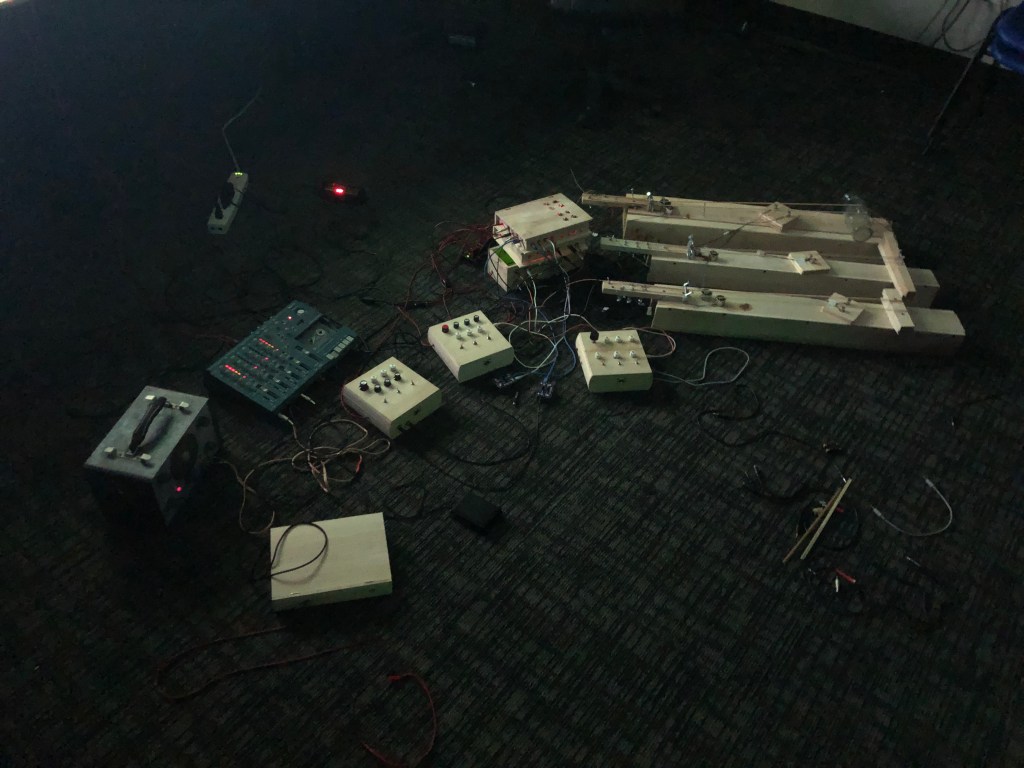
a feedback loop of sensorial processing. By amplifying the electro-magnetic string
resonators and using combinations of sine waves to generate the magnetic field of
the exciters, the signal then flows back through another set of electro-magnets, and
sound emits from speakers, which then influences the instruments output by
creating a controllable feedback loop through the air.
The feedback loop is essential to this practice as the participant becomes a
part of the cycle. Engaging with the flow of sonic action dictates the change of
events, intuition acting on instantaneous receptions. Through this, temporal
perception dissipates, and the experience becomes fluid.
“Musical vibrations also affect other cells types in several organisms… Effects on
growth, apoptosis, immune system, protein activities in animal, plant and bacterial
cells have been shown.” (Some Effects of Sound and Music on Organisms and
Cells: A Review. Annual Research & Review in Biology, 32(2), 1-12).
“Sound waves can enhance plant immunity against pathogens” and influence
“plant growth and development.” (Some Effects of Sound and Music on8
Organisms and Cells: A Review. Annual Research & Review in Biology, 32(2), 1-
12).
“In Escherichia coli, audible sound increases the colony forming under the normal
condition and enhance the inhibitory effect of osmotic stress.” (Some Effects of
Sound and Music on Organisms and Cells: A Review. Annual Research & Review
in Biology, 32(2), 1-12).
“Music therapy induced alterations in natural killer cell count and function.” (Some
Effects of Sound and Music on Organisms and Cells: A Review. Annual Research
& Review in Biology, 32(2), 1-12).9
Chapter 3
Gravitational Waves & Electromagnetism
Gravity and magnetism are distinct forces in physics, each governed by its
own set of principles and equations. While they share some similarities, they are
fundamentally different phenomena.
Gravitational wave theory represents a groundbreaking domain in physics,
dealing with the ripples in spacetime caused by the acceleration of massive objects.
These waves, first predicted by Albert Einstein, are particularly significant in
events involving intense gravitational interactions, such as merging black holes or
neutron stars. By providing insights into the properties of massive objects, the
nature of spacetime, and the dynamics of extreme astrophysical events,
gravitational waves are revolutionizing our understanding of the cosmos.
Einstein formulated the general theory of relativity in 1916, which predicted
the existence of gravitational waves. This theory states that massive objects cause
spacetime to curve around them, and when these objects accelerate, they produce
gravitational waves that propagate at the speed of light. Gravitational waves are
distinguished by their ability to stretch and compress spacetime as they travel
through it. These waves carry energy away from their source, causing distant
objects to oscillate in response to their passage. The behavior of gravitational
waves is described by the linearized form of Einstein’s field equations, leading to a
wave equation that predicts how these waves propagate through spacetime.
Gravitational waves are most significant in binary systems, where two massive
objects orbit each other. The strongest waves are expected from events like the
merger of black holes or neutron stars. These waves can be produced by various
astrophysical events, including the in-spiral and merger of binary black holes,
binary neutron stars, supernovae, and asymmetrically collapsing massive objects.
The first direct detection of gravitational waves occurred on September 14,
2015, by the Laser Interferometer Gravitational-Wave Observatory (LIGO),
confirming Einstein’s theory. This detection, resulting from the merger of two
black holes, marked a significant milestone in astrophysics.
Gravity interacts with temporal perception on Earth primarily through the
phenomenon of gravitational time dilation. Gravitational time dilation occurs
because gravity warps the fabric of spacetime, affecting the passage of time in
regions with different gravitational potentials.
According to general relativity, time passes more slowly in regions of
stronger gravitational fields compared to regions of weaker gravitational fields.
This means that clocks closer to massive objects like the Earth tick more slowly10
relative to clocks farther away. While gravitational time dilation affects the physical
passage of time, its direct impact on human psychological perception of time is
less clear. Human perception of time is influenced by a variety of factors, including
cognitive processes, emotions, and environmental stimuli. the experience of time
may indirectly be influenced by gravitational effects, such as the gravitational time
dilation experienced by astronauts in space, which can lead to a subjective sense of
time passing differently under certain conditions.
“Our sense of extension in space can be traced to the orderly pattern in which
receptors sample the retinal image, but there is no equivalent orderly arrangement
of receptors designed to register temporal patterns. This makes space perception
and time perception different from the outset, and renders mysterious the neural
mechanisms by which we sense the time course of events…
Recent experiments show that synchronous events can appear to an
observer to occur at different times. Neural processing time delays are offered as
an explanation of these temporal illusions…
In the neural processing delay approach, which we call the ‘brain time’
theory, time is treated quite differently from other sensory attributes… The
alternative, called the ‘event time’ theory, posits that we may have specialized
neural systems that encode the relative time of external events.” (Time perception-
Brain time or event time?, p.1).
“Temporal processing is tightly coupled with other sensory modalities and is
influenced by physiological states, potentially involving interactions with
gravitational and electromagnetic fields.” (Timing and Time Perception, Ch. 2, p.
32).
“The perception of time can significantly differ under various physiological
conditions and in response to natural or experimental modifications in
environmental stimuli, including changes in electromagnetic fields.” (Timing and
Time Perception, Ch. 13, p. 295).
Magnetism, on the other hand, is a force associated with certain materials,
particularly those containing atoms with magnetic moments. These materials can
be attracted or repelled by a magnetic field. The fundamental unit of magnetism is
the magnetic dipole moment, which arises from the motion of charged particles
within atoms. It can be attractive or repulsive, depending on the orientation of the
magnetic dipoles. Magnetism is effective over shorter distances and is more
noticeable in materials with aligned magnetic domains.
Magnetism can affect human physiology in several well-documented ways,
primarily through the interaction of magnetic fields with biological tissues.11
Magnetic fields interact with biological systems in diverse ways, some of which are
beneficial and harnessed in medical technology. Some animals have the ability to
detect magnetic fields (magnetoreception), which they use for orientation and
navigation.
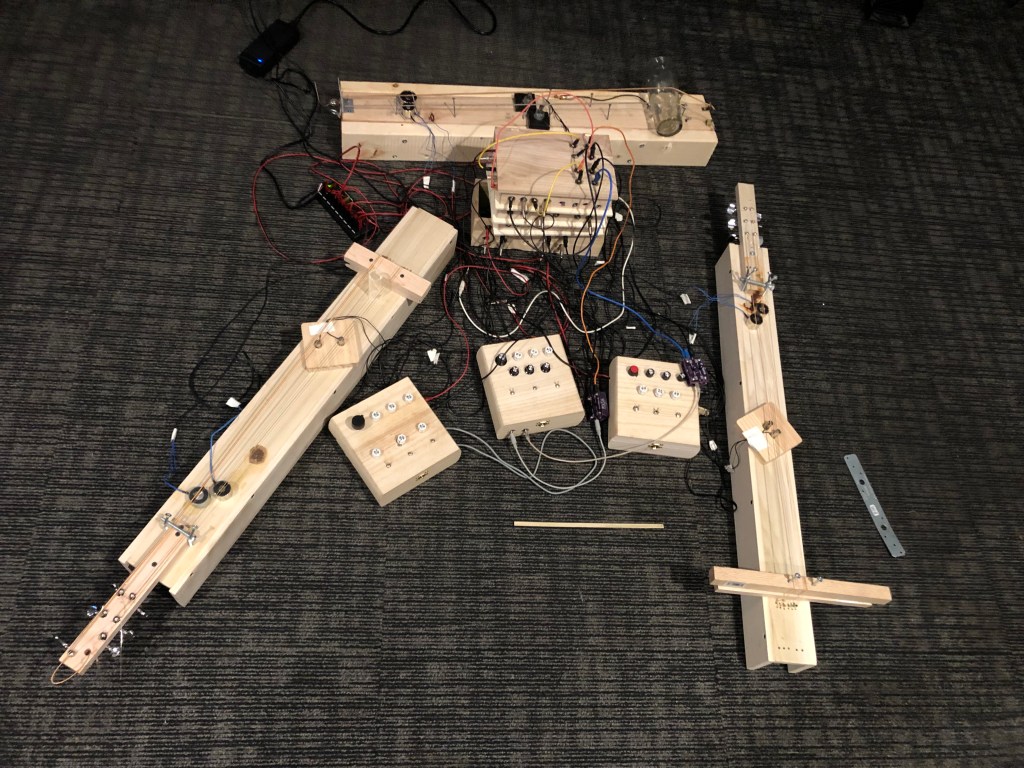
The electromagnets that generate the wave fields on my instruments are
controlled via audio signals, rather than a fixed voltage, sent from a stand-alone
microprocessor called the Daisy Seed by Electro-smith. A compact and highly
versatile tool that is customized to produce a stereo audio signal comprised of sine
waves in an FM synthesis configuration. The signal is scaled so that the waves can
be tuned below the audible range up to as far as the digital processor can go, which
induces aliasing and odd, fragmented difference tones. This allows for resonances
of the string that can scan up and down the natural harmonic series. When the
oscillators are in the audible range I’m able to pin-point and sustain harmonics
perpetually. The strings are amplified by 2 smaller electromagnetic pick-ups made
from recycled bullet shells. The amplification stage, when used with a mixer with
auxiliary sends and returns, allows the instruments to be fed back into themselves
in various ways. The magnetic fields of fluctuating frequencies and amplitudes
represents how forces can contain and distribute information or energy through
space and time, in this case on a string.12
Gravity Wave Fields are incredibly complex, so I experimented with
generating some images using AI to attempt some different iterations.131415
Chapter 4
Natural Technologies
:
Viktor Schauberger
Viktor Schauberger was an Austrian forester and naturalist born in 1885 and
is celebrated for his revolutionary theories and pioneering principles that have
challenged and enriched conventional approaches in ecology, engineering, and
sustainable development. His deep connection with nature and keen observation
of its processes led him to develop groundbreaking theories and technologies,
deeply rooted in a holistic understanding of natural systems. Schauberger’s work,
grounded in observations of water, forests, and ecosystems, provides invaluable
insights into sustainable practices and biomimetic design, making his legacy
particularly relevant in contemporary environmental contexts.
Schauberger’s life was characterized by an intense connection to and
understanding of nature. Contrary to prevailing scientific paradigms of his time,
Schauberger emphasized the significance of working with, rather than against,
natural processes.
“Nature’s rhythms are not random; they are the harmonious interactions between
electromagnetic fields and the gravitational forces of Earth, orchestrating a
symphony of temporal patterns that affect biological and ecological processes.”
(Living Energies, p. 74).
Central to Schauberger’s theories is the concept of implosion, a process
involving inward movement or compression, unlike explosion which is outward
and destructive. Schauberger applied this concept to various technologies,
proposing designs that harness implosive forces for energy production and
transportation. His implosion-based devices, like the “Repulsine”, were designed to
mimic natural processes, aiming to minimize environmental impact.
“The natural cycle of water and its energy dynamics are crucial for maintaining the
physiological balance within ecosystems, subtly influencing the temporal
perception of all living organisms.” (Living Energies, p. 108).
Schauberger was a strong advocate of biomimicry, the practice of emulating
natural systems and processes to address human challenges. He believed that
nature holds the keys to sustainable technologies and designs, drawing inspiration
from natural phenomena such as vortex motion and the spiral forms in living16
organisms. His approach to biomimetic design has informed innovative
technologies in energy generation, water purification, and agriculture.
Schauberger proposed that water possesses a “living energy” that sustains
life and regulates ecological processes. He emphasized the importance of
preserving water’s natural vitality through gentle handling and structured flow. His
observations led to the development of vortex-based technologies aimed at
revitalizing and purifying water without chemical intervention. While some view
his theories as speculative, others regard them as ahead of their time and worthy of
further exploration. His concepts have been applied across various fields, inspiring
innovative approaches to resource management and design.
“Water’s flow patterns and its interactions with gravity not only sculpt the physical
landscape but also shape the temporal landscapes we perceive, directly impacting
our physiological experiences.” (The Water Wizard, p. 107).
Schauberger’s ecological insights have influenced ecologists and
environmentalists seeking holistic approaches to ecosystem management and
restoration. His emphasis on the interconnectedness of natural systems and the
importance of respecting ecological balance aligns with contemporary efforts to
promote biodiversity and sustainability.
“Soil fertility is not static but is a temporal phenomenon influenced by the
electromagnetic properties of the earth and the cosmic interplay of gravitational
forces, which in turn affect plant growth and ecological stability.” (The Fertile
Earth, p. 47).
“By understanding the alchemical transformations water undergoes in nature,
influenced by electromagnetic and gravitational fields, we can better understand
the subtle nuances of temporal changes in our environment.” (The Water Wizard,
p. 108).17
Chapter 5
Mycelium & Bioremediation in Los Angeles
:
Explorations of Natural Time Processes
I first learned of Bioremediation from the Soundscape Ecologist Bernie
Krause. I’d also been aware of John Cage’s interest in Mycology and the work of
Dennis & Terence Mckenna, Maria Sabina, John Sinclair until ultimately learning of
Paul Stamets in 2015. He has been a leader in Mycological research for decades and
from his literature is where I learned about Mycoremediation and Mycofiltration.
Using information from his studies, and with some additional DIY research online,
I began the primary stages of making a Mycofilter in December 2023. I began with
inoculating a substrate with three different species of fungi, Stropharia rugosa annulat,
or Garden Giants, and Pleurotus ostreatus and Pleurotus ulmarius, two species of Oyster
Mushroom. The substrate was then mixed into a burlap sack of fermented hay and
by February 2024 the entire burlap had been completely inoculated. Initially I had
the intention of experimenting with this technology on CalArts campus, however,
since January 2024 I have been a member of the Eco-social Art organism known as
Untune, led by artist Helga Fassonaki and located on a residential property in
Highland Park, Los Angeles. On that property we are maintaining a garden of Native
plant species and I have constructed and installed a Myco-filtration system that
collects drainage from a utility sink and is exposed to the elements so that it can
retain rain moisture as well.
Water contamination in Los Angeles, like in many urban areas, can arise from
various sources and contaminants. Rainwater runoff from streets, parking lots, and
other urban surfaces can carry pollutants such as oil, heavy metals, pesticides, and
debris into water bodies. Some industrial activities may release contaminants into
water sources. These contaminants can include chemicals, heavy metals, and other
pollutants. In areas surrounding Los Angeles with agricultural activities, runoff from
fields may carry pesticides, fertilizers, and sediment into waterways. Although
wastewater treatment plants treat sewage and other waste, there may be instances
where treated effluent still contains residual contaminants. Contamination of
underground aquifers can occur due to industrial spills, leaking underground storage
tanks, or improper disposal of hazardous materials. Some areas may have naturally
occurring contaminants in their water sources, such as high levels of minerals or
elements like arsenic.18
Aging water infrastructure can contribute to water contamination. For
example, deteriorating pipes may allow contaminants to enter the water supply.
Bacteria, viruses, and other microorganisms can contaminate water sources, posing
risks to public health. This can be a concern in areas with inadequate sanitation or
issues with water treatment.
The management of runoff in Los Angeles is a critical aspect of urban
planning and environmental stewardship due to the region’s complex water
infrastructure and susceptibility to droughts and flash floods. Runoff, which
includes rainwater or water from irrigation, can carry pollutants and contribute to
water quality issues if not properly managed. Los Angeles, like many other cities, has
a Stormwater Management Program to address runoff issues. The program aims to
reduce pollution in stormwater runoff and protect water quality. It includes
measures such as public education, regulatory compliance, and infrastructure
improvements. Low Impact Development practices focus on managing stormwater
at its source. Examples include permeable pavement, green roofs, rain gardens, and
other measures designed to mimic natural hydrological processes and reduce runoff.
City planners and developers in Los Angeles may incorporate sustainable design
principles to minimize impervious surfaces, increase green spaces, and implement
features that help manage stormwater on-site. Some areas use retention and
detention basins to manage stormwater. Retention basins hold water permanently,
while detention basins temporarily detain stormwater before slowly releasing it to
prevent downstream flooding. Los Angeles has an extensive network of concrete-
lined flood control channels designed to quickly move stormwater away from urban
areas to prevent flooding. However, these channels can contribute to water pollution
by quickly transporting pollutants to rivers and coastal areas. There are regulations
in place to control stormwater runoff from construction sites and industrial facilities.
The National Pollutant Discharge Elimination System (NPDES) permit program,
administered by the EPA and the State Water Resources Control Board, sets
guidelines for controlling stormwater runoff.
Mycelium, the vegetative part of fungi, has a porous structure that can filter
water. Mycorrhizal fungi form symbiotic relationships with plant roots, enhancing
nutrient uptake. Inoculating degraded soils with mycorrhizae can improve plant
growth, increase soil stability, and aid in the establishment of vegetation in barren
areas. Using fungal mycelium mats in constructed wetlands or filtration systems can
help remove pollutants and improve water quality. Certain fungi have the ability to
break down organic pollutants in water. Introducing these fungi to polluted water
bodies can aid in the natural breakdown of contaminants. Implementing
mycofiltration systems in urban areas can help manage stormwater runoff. Mycelium
acts as a natural filter, capturing pollutants and preventing them from entering
waterways. Certain fungi, known as hyperaccumulators, have the ability to absorb
and accumulate heavy metals from contaminated soils. Integrating these fungi into19
soil remediation strategies can help detoxify polluted areas. Fungi, along with
bacteria and algae, can form biological soil crusts that stabilize soil, prevent erosion,
and improve water retention. These crusts are particularly valuable in arid regions
like Los Angeles. Fungal mycelial networks can act as natural connectors in
ecosystems, facilitating the establishment of plant communities. This is particularly
useful in restoring habitats in urban areas.
Incorporating mycorrhizal fungi into urban greening initiatives can enhance
the resilience of planted trees and vegetation in city parks and green spaces.
Community-based mushroom cultivation projects can turn organic waste into
valuable resources. By educating communities about mycology and sustainable
practices, there can be a dual benefit of waste reduction and local economic
development. Engaging the community through workshops and outreach programs
can raise awareness about the importance of fungi in ecological restoration and
water management.
This has been the fundamental purpose of my work with Untune in Los
Angeles. Reading groups discussing distribution, waste management, plant
variability and water treatment. Communal meals sourced from local distributors
and personal gardens. Art explorations utilizing dyes and charcoals from different
organic materials. Gardening practices and soil treatment. All aspects of what the
organization has begun to provide for its participants.
Below are few images from a larger collection of documentation of the
Untune property, garden and mycofiltration system.2021222325
Conclusion
Unraveling the Temporal Threads
The philosophical underpinnings of my work reflect a deep commitment to
understanding the intrinsic connections between sound, time, and existence. By
adopting a holistic approach that values subversion and reflection, this documents
my on-going attempts to challenge the prevailing norms of technological and
ecological interaction. Artists have the ability to experiment with models where
innovation coexists with the natural world rather than exploits it.
Comprehension of the numerical relationships in nature and the timescale of
natural processes are fundamental in the remediation of both our natural
environment as well as the human psyche. The path for understanding lies in
experimental practices that subvert the inherited structures of society, such as
technological and ecological regulations that hinder our progress. Over the course
of the 20th century, there were countless practitioners of science and engineering
who sought alternative sources with which to liberate humanity’s destructive
addiction to “explosion energies” which emit gases into the air. All vanished from
the earth before fulfilling their studies and history has let them slip into obscurity.
Experience is the foundation to understanding and therefore the state of the
whole relies on the awareness and depth of the individual. Through my various
practices, my goal as an artist is to pursue this exploration into natural and alternative
technologies, allowing time to be dictated by the system or process, with the
intention of realizing the result back into the physical and /or acoustic form. To be
open to non-societal time scales as a means of creating work that has minimal
environmental impact and maximum critical affect in the form of message.
As we travel through this stage of technological transformation, it is crucial
that we reassess our relationship with nature and our methods of technological
engagement. I urge future researchers and practitioners to explore the vast
possibilities of sound not only as a scientific tool but also as a medium for profound
ecological and personal transformation.
Looking forward, the implications of this research extend beyond the
academic and into the practical realms of environmental science and mental health.
I envision a future where sound therapy and sound-based environmental
remediation become mainstream practices, integrated into public health strategies
and ecological management plans. The potential for these technologies to improve26
quality of life and restore ecological systems offers a hopeful outlook on the
challenges of modernity.27
Bibliography
– Exbrayat, J.-M., & Brun, C. (2019). Some Effects of Sound and Music on
Organisms and Cells: A Review. Annual Research & Review in Biology,
32(2), 1-12
– Timing and Time Perception: Procedures, Measures, and Applications
– Psychology for Musicians
– Time perception: Brain time or event time?
– The Psychodynamics of the Numbers
– The Fertile Earth, Viktor Schauberger
– The Water Wizard, Calum Coates
– Living Energies, Viktor Schauberger
– Nature as Teacher, Viktor Schauberger
– Deep Listening, Pauline Oliveros
– Bartel, L., & Mosabbir, A. (2021). Possible Mechanisms for the Effects of
Sound Vibration on Human Health. Healthcare, 9(597), 1-35. DOI:
10.3390/healthcare9050597
– Oomen, P., Farran, B. M., Gentile, D., et al. (2023). Deviations in Sound Waves
Associated with Physiological and Psychological States. Journal of Sound and
Vibration.
– https://thewaternetwork.com/article-FfV/mycofiltration-harnessing-fungi-
to-clean-polluted-water-0oIXXU4D4-DVl7Gvs0jZiw
 m-b
m-b 